
Manga
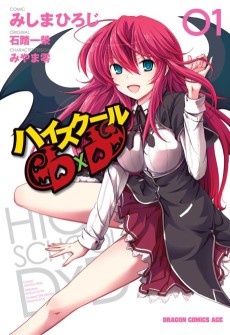
High School DxD
Manga
Rey del Harem (reseña en ESP y ENG)
40 NapoJJul 17, 20263 of 6 found this helpful
La siguiente reseña está en Español e Inglés (traducida con el apoyo de DeepL)
La versión leída es la licenciada al español por “Ivrea España”
Adaptación manga publicada entre 2010 a 2018, es decir que cubre a 2012 - 2015, la etapa de mayor popularidad que tuvo la franquicia. Y de ahí el propósito de la misma, este es un proyecto “promoción” más que “visión”. El dibujante es Hiroji Mishima el cuál sólo es el artista, la historia la escribe el mismo creador de la novela ligera Ichie Ishibumi.Y dado su punto de origen, es más promoción de las novelas que del anime.
Por eso he abordado la reseña desde la posición de ser una “adaptación”, a la premisa y a los personajes ya les he “aceptado”. Es una historia tipo harem ecchi con elementos mágicos y mitológicos, y de manera personal, una de mis favoritas dentro de su género, añejada por una década de nostalgia. No hay mayor profundidad, ni es que pretenda conseguirlo, en ese punto se le puede considerar una obra muy honesta con quien es y a qué público quiere; no por ende la hace inválida de crítica ni la vuelve sobresaliente, nuevamente, si vas a la misma es porque sabes que esperas y te interesa ver hacia dónde se dirige.
Partamos de su estilo visual, más cercano a la novela ligera que a los delineados finos y estilizados de la adaptación animada. Su artista tampoco es particularmente experimentado, de ahí que era una posición por completar, en vez de construir una identidad visual diferente. Este estilo entremezclado con la novela ligera terminaría dictando el aspecto de la reinvención de la cuarta temporada “Hero”.
~~
El dibujo mejora conforme avanza la historia, sus primeros capítulos no se ven de la escala ni el detalle que se merecía, se nota el cambio en cuanto a la experiencia que va obteniendo Hiroji o por la influencia del anime, los trazos definen mejor a los personajes durante sus batallas, y son más suaves en los momentos cómicos y de cotidianidad. En sus momentos eróticos son aceptablemente correctos, no comparables a otras referencias del género, más tampoco una decepción para el excelente grupo femenino de la novela.
Lo que poco mejora, aunque sí que la tiene, es el posicionamiento de los personajes y el establecimiento de la acción, es muy básica, se compara al estilo de planteamiento habitual en los principiantes. Habiendo una rica base de elementos, como simbología de diferentes religiones, que sí salvando las distancias está en su subgénero, poco se utilizan, priorizando fondos y estilos comunes. No hay nada a nivel de planteamiento visual que dé identidad a esta adaptación.
Para mal si tiene un detrimento en su formato, se empaña por un diálogo excesivo en varias secciones. Dadas las complicadas reglas comunes, características en las novelas ligera, sea por falta de imaginación o no ocupar innecesariamente paneles, se prefiere largas burbujas de texto que aburren rápidamente, y con las cuales podría tener un entendimiento dado a ser un compendio monolítico de reglas y técnicas, de no ser que también lo notamos en conversaciones escolares o trasfondos de personajes.
~~
Sí hubiera preferido que se expandiera a través de momentos que sólo se puedan conseguir en su formato, por ejemplo, otros estilos artísticos en instantes cómicos, abusar de la ilustración para enaltecer la parte erótica en esas absurdas casualidades o comunicar visualmente ciertas ideas, sin embargo, nada de lo anterior es conseguido, sólo cumple de la forma más básica su propósito de ser una adaptación.
La historia adapta poco más de la tercera temporada, puesto las diferencias entre el anime y la novela ligera, terminando de forma abrupta precisamente alineado a su propósito establecido de ser un “vistazo” en vez de una visión paralela. Aún teniendo especial cariño por este formato, me es imposible no considerarlo como una oportunidad perdida, en vez de algo que ser valorado por su propia cuenta; de todas formas sí que me lleva a tener anotado en mi infinita lista de espera el leer su novela ligera, espero haya conseguido lo mismo para otros alineados en los mismos intereses.
~~
English
This manga adaptation was serialized between 2010 and 2018, covering the franchise's peak popularity from roughly 2012 to 2015. That context largely defines its purpose: this is a project driven more by promotion than by creative vision. The artwork is handled by Hiroji Mishima, who serves solely as the illustrator, while the story is written by the original light novel author, Ichiei Ishibumi. As such, the manga functions more as a promotional companion to the light novels than to the anime adaptation.
For that reason, I approached this review from the perspective of an adaptation. I have already accepted its premise and characters on their own terms. It is an ecchi harem story infused with magical and mythological elements and, personally, one of my favorite entries within its genre, strengthened by more than a decade of nostalgia. It is not a particularly profound story, nor does it attempt to be. In that sense, it is remarkably honest about what it is and the audience it seeks to entertain. That honesty neither shields it from criticism nor automatically makes it outstanding; once again, if you pick up this series, it is because you already know what to expect and are interested in seeing where it goes.
Starting with the visual presentation, the artwork remains much closer to the light novel illustrations than to the clean, refined character designs of the anime adaptation. Mishima was not a particularly experienced artist at the time, making his role one of faithfully completing the adaptation rather than establishing a distinct visual identity. Interestingly, this hybrid style between the manga and the light novel would later influence the redesigned aesthetic adopted by the anime's fourth season, Hero.
~~
The artwork steadily improves as the story progresses. In the earliest chapters, the illustrations lack the scale and level of detail the series deserves, but Hiroji's growing experience—or perhaps the influence of the anime—is clearly reflected over time. Character designs become more defined during battle scenes while adopting softer linework in comedic and everyday moments. As for the erotic scenes, they are perfectly serviceable: not comparable to the genre's finest examples, yet far from disappointing considering the excellent female cast created for the original novels.
What sees far less improvement, despite some progress, is the staging of action and character positioning. The visual direction remains very basic, resembling the conventional approach often seen in inexperienced artists. Despite having access to a rich foundation of religious symbolism and mythology—knowing its subgenre—the manga rarely capitalizes on them, instead relying on generic backgrounds and familiar compositions. Ultimately, there is little in its visual storytelling that gives this adaptation a unique identity.
Unfortunately, the format also suffers from another significant weakness: excessive dialogue. Given the intricate systems of rules and abilities that are typical of light novels, the manga frequently resorts to lengthy speech bubbles, whether due to a lack of visual creativity or a desire to avoid dedicating additional panels to exposition. While this might be understandable when explaining the world's mechanics and techniques, the same verbosity also affects ordinary school conversations and character backstories, quickly becoming tiresome.
~~
I would have preferred the adaptation to embrace strengths unique to the manga medium—for example, experimenting with different artistic styles during comedic moments, using illustrations more boldly to enhance the ecchi humor born from its absurd coincidences, or conveying certain ideas visually rather than verbally. None of that truly happens. Instead, the manga fulfills its role as an adaptation in the most straightforward and functional way possible.
The story adapts little more than the third season, given the differences between the anime and the light novel, ending abruptly—precisely in line with its stated purpose of being a “glimpse” rather than a parallel narrative. Even though I have a special fondness for this format, I can’t help but see it as a missed opportunity rather than something to be appreciated on its own merits; in any case, it has prompted me to addreading the light novel to my endless to-read list—I hope it has had the same effect on others with similar interests.
~~