

I was waiting for this episode, as I was told that this is the best chapter of the novel. This is completely shit. Ez drop.
 CoolestLegend27Oct 23, 202035 replies863 views
Anime only here
From now on, I'm just gonna assume that the rest of this anime is just gonna be dark (though that doesn't mean I hate it. I still like this series and I'm looking forward for more)
I was waiting for this episode, as I was told that this is the best chapter of the novel. This is completely shit. Ez drop.

I think Elaina is meant more as a narrator than the main character. I think that makes sense. I enjoyed the fight with Javalier, and I thought the look of the city was cool.

I love the way they presented the story between the princess and the servant.
They did a great job with Javalier too.
Poor Mirarose... I also feel bad for the kingdom’s residents who were devoured by the Javalier.
Excellent adaptation. This is one of the better stories from the first light novel.
I'm just gonna assume that the rest of this anime is just gonna be dark
There will still be some lighthearted stories. Not sure how much of the second volume they're going to adapt... Many of those stories in that volume are incredibly dark.
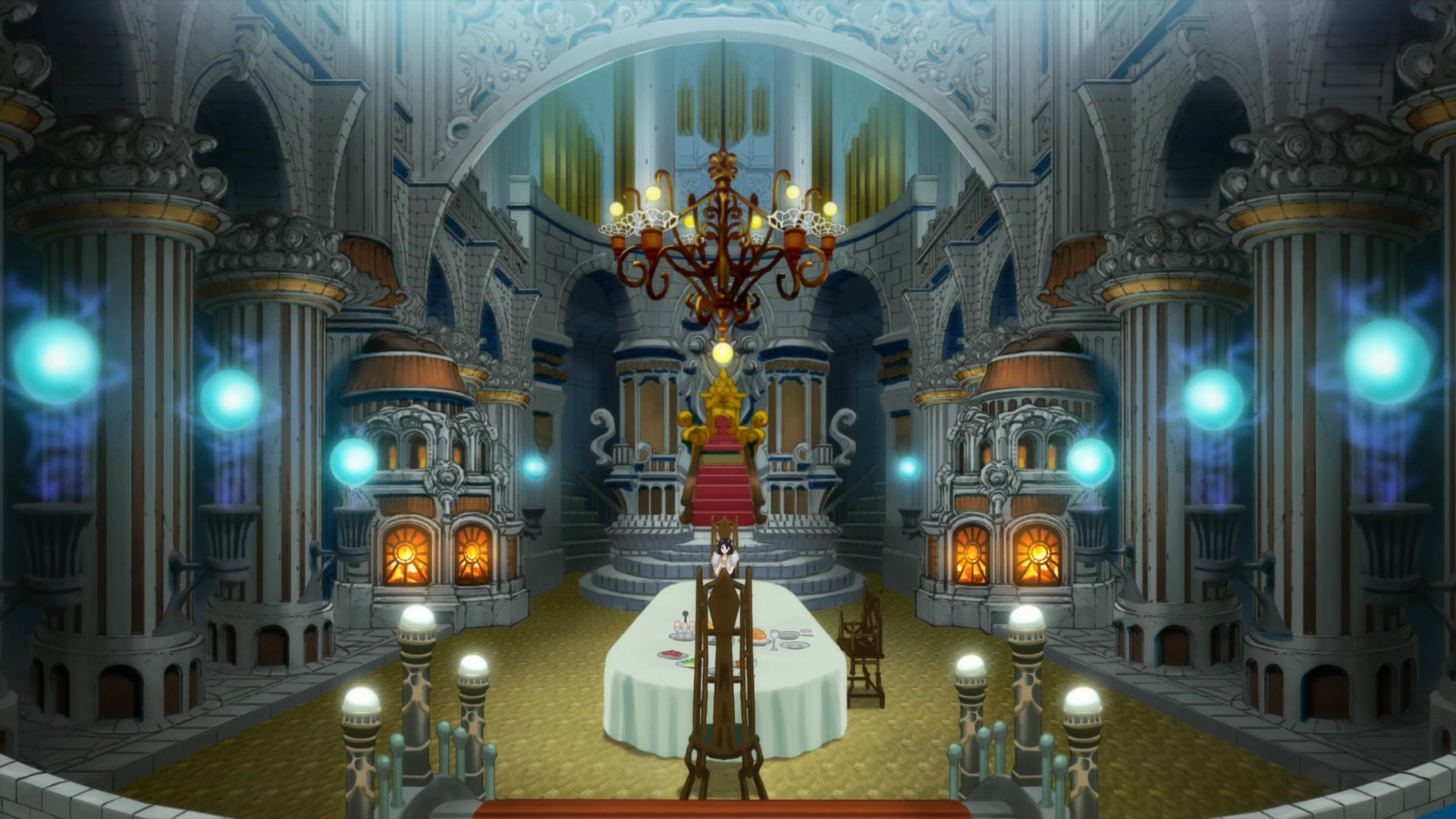
Another thing I enjoyed about this episode was the scenery. Looked so detailed and beautiful. I mean, it's been beautiful so far but this episode's scenery and backgrounds were fantastic. Really happy with the adaptation so far.

0/10 Garbage episode. Elaina didn't compliment herself at the beginning

Agree. In Episode 3 Elaine didn't help nino, in the end nino commited suicide. Why wasted my time watch a main caracter that don't do nothing, just watch?
[Removed]
that's why I dropped, it's wast of time watch a MC that don't do nothing.
I really don't like Elaine's selfishness and self-centeredness. successfully dropped
Yeah.. She cares only about herself too much at this point
She said she was gonna help during the battle, but she ended up not needing to cuz that princess was already obliterating it. What did you want her to do?
Very cool an adventure anime where the main character does nothing, just watches the tragedies. In Episode 3 Elaine didn't help nino, in the end nino commited suicide. Why wasted my time watch a main caracter that don't do nothing, just watch?

This episode was pretty weak for me.
I haven't seen a show go so bad so fast like this one in a while. This was even worse than the last one, bad execution of these overly dark concepts and does not at all fit the first 2 episodes tonally. What are they DOING? Dropped.

I liked this episode more than Ep 3. Elaina at least becomes active in the story again, and this particular story has a mysterious element. So, even if she doesn't battle the dragon-spider-thing or lead to its defeat, she is still working towards uncovering the mystery. But it still ended up falling flat for me. There's an existential ennui to these last two episodes that leaves them really lacking IMO. Something started bothering me and I think I was able to figure it out with this episode:
What is Elaina's goal? What is her arc? What are the stakes? And more fundamentally: why did she want to be a witch in the first place?
I went back to the first episode. The most we learn is that she read a book of memoirs written by a traveling witch. It seems like her goal is to live a similar life, to experience similar things, and to travel. That is a human goal, and a good premise for a series that explores a lady growing up in such a world, gaining experience, wisdom, and conveying that knowledge to others.
The real problem is that we see NONE of that. By the end of the first episode, we've skipped the 4 crucial, formative years of her life, and from that point on we see her as a fully-developed character. By this time, she has achieved her goal. She is a traveling witch and writing memoirs just like her role model.
And from that point on, the series loses its purpose and drive. There's no more learning; there are only events and reactions. There's nothing she's running away from and nothing she's running towards. There's nothing left to gain or to lose. Those around her are not bettered by her being around (and in the last episode, they were decidedly in a worse position after meeting her). There's no stakes. It's just... being. She's just experiencing stuff purely to experience it.
It kind of has the feel of a postmodern series. A series that, at its base, values any story that is told as equal to any other story that is told. The idea that all stories are literally equal in value. And while I can't say that postmodernism is inherently wrong or anything, it does remind me of a saying that I tend to identify with. "If you don't stand for anything, you'll fall for everything." I don't know that this series stands for anything.
I hope I'm wrong.

At least we get to see another budget flex this episode! story aside, the animation is amazing. The fight with Javalier is surprisingly engaging, and the twist is well-brought. I especially love the sound directing!
and that's all the praises I have for this episode. My initial problem with the series is still there, with Elaina's characterization being very inconsistent or obscure. She's not really the type of character to look up to, however that doesn't mean she's unlikeable. I'm still disappointed for the lack of internal monologue from Elaina's perspective. We still don't understand how her mind works or what the hell is she thinking about most of the time. It makes it hard to relate to her, at least for me.
Also, unlike the previous episode that mostly feel like a filler, this episode has a proper, fascinating closure. Most of the time this anime ignores the "show, don't tell" rule of storytelling, but this episode really does show
My expectation rises up again after getting down from the last episode. I hope it's getting better from now on as well.

It's decent overall but feel like it's just a more heavy-handed Kino no Tabi with flashier production values. There's enough to keep me watching but there's also something a bit too flippant about its "darker" moments.

I'm not sure people are understanding the point of the series from this recent episode and even the last one. Elaina is a traveler, not a saint. wtf do you want her to do?
[Removed]
Yeah I also like it, but I'm generally wondering what people wanted her to do this episode. The whole country was already dead

It feels more liek Kino's Journey and I like it. I like Elaina acting as a spectator.

I personally liked this episode a lot. I like the Elaina is someone willing to burn down someone's door or refuse to help them in a crucial fight unless there's a selfish purpose. She's not a heroic character, nor is she even inspired or thinking about heroism. Her goal of becoming a witch was entirely selfish and was not based on obtaining a power to help others. She wants the power to live a type of lifestyle and she's living it.
to me the severe tonal change and darker subject matter was hinted at from the beginning. Elaina was made to promise her mom that if things ever got dangerous, she would run away. That immediately told me that Elaina's adventures are all not going to be "vacations" but that some of them could involve mortal peril of some sorts. And where there's mortal peril, there tends to be stories like this.
And yes, the production is fantastic. That part I don't really have to debate. Some of those shots have me straight up thinking of Anor Lando in Dark Souls.
~~~She Became The Princess Without Subjects By Her Own Hand...
 ~~~
~~~

this show is so fuckin good
This shit is getting kind of grim. I expected a comedy/slice not a drama.

dark episode again. But the king was asking for it.. burn alive the man that his daughter loves. Also I assume the child was burned as well.
Elaina helped a lot, digging a hole to exhaustion of herself. Also willing to risk her life fighting the monster, in case Mirarose needed help.
however, it turned out Mira has some screws loose already. Elaina did the right thing getting out of that place. Who knows what that crazy person might do to her.

I just finished this ep. and can't stop wondering how things ended that way if Mirarose is that powerful?? Is there some background about that in the LN?

Just wanted to say that I enjoyed the Dark Souls-like feel of this episode; Dark Souls 3 especially.

:( Yep
She didn't expect Nino to commit suicide, as she didn't remember the end of the story until way later on.
[Removed]
Very cool an adventure anime where the main character does nothing, just watches the tragedies
Episode 3 Elaine didn't help nino, in the end nino commited suicide. Why wasted my time watch a main caracter that don't do nothing, just watch?

I take what you say at heart because you asked what I think is the most crucial question to understand this anime, namely: why did Elaina want to be a witch?
As you said, she became a witch, her childhood goal is achieved. But perhaps being a witch, rather than becoming, has brought that same crucial question back to light. She is now writing memoirs, and this continuous endeavor is a testimony to her learning. She learned to become a witch, and it could be that now she learns to be a witch. I don't have an answer to this "crucial question," but you'll have to forgive me for piggybacking on your angle of thinking to share mine. As an opponent of post-modern literature it rings as curious to me that you relate Majo no Tabitabi to it, as it is an anime in which I discern plenty of purpose, but I can see your point. It is a typical travel story in terms of showing someone neutrally adventuring through the world. And when I say I'm piggybacking here I really mean it, which means you aren't necessarily meant to reply to me.
Some of my close online friends don't like this anime, but I do, and something about it invites me to revel in its sheer nature. Majo no Tabitabi's recent episodes have been wretched right on the surface and would break open a lot of feelings for one who isn't accustomed to indignation. It's no wonder some people wouldn't know what to feel about it or would straight-up feel annoyed by it.
Elaina travels around the world with no known aim. Everywhere she goes, she encounters various cultures and customs and meets many people, but to never stay in one place and to go on with your journey is what makes a traveler, a traveler.
There are various things that you can focus on when writing a travel story. For example, touching on unknown cultures and customs can be a theme. However, it is important to know that, in this work, the author makes it a point to focus on "encounters and farewells generated through travel" (to roughly put it in his words).
In the original novel, and as proven by the anime, there are some episodes in which the newly encountered character has no saving grace. The author willingly wrote his stories this way. He was inspired by foreign serialized detective dramas in which the characters often have an unfortunate demise (he calls it "thorough misfortune"). The author recognizes that readers would not be pleased with a constant allegiance to dark stories, and that is why he has set himself a standard to keep dark content in moderation (perhaps we will get happy stories now and then). However, he also considers that "stories with no salvation from start to finish" can be imagined precisely because of an episodic format. Perhaps a good comparison would be 19th century European fairy tales that were short and commonly had unfortunate endings.
The author also mentioned his liking for the dialogue ridden with cynicism you can find in British drama, and that this particular taste has transferred into Majo no Tabitabi's dialogue. This could explain Elaina's attitude at certain points.
It's interesting to know that the author has not planned an ending for the story, although he does have a vague idea that it would be about Elaina's hometown. And so we could wonder if some kind of apotheosis will be reached and if Majo no Tabitabi could be said to be a story about Elaina's growth as a person. As I implied in my first paragraph, I don't believe the first episode was meant to put a final stop on her development. We'll have to see what the anime has to offer in that case.
I don't agree with anyone who has called Elaina "a narcissist who is full of herself." She does take pride in the hard work she previously put in to become a witch, and does not shy away from any opportunity to brandish her witch emblem as proof of that, and to reveal a smirk whenever someone is excited to meet "someone like her." That much is true— but Elaina is the opposite of a narcissist if we take the word for its true meaning.
The myth of Narcissus tells of the vulnerability hidden beneath the strong personality of certain people (in the case of the myth, the character Narcissus represents these people). Without control over other people's feelings, the narcissist feels weak and disgraced. They have unconscious disdain for their own vulnerable feelings of shame, as they evoke their need for someone to rely on, which would ultimately expose them to rejection. They attempt to overwhelm this shame by compensating with independence, courage, and strength, ideals with which they identify.
The point here is that while narcissists feel superior to others, they depend precisely upon others to reflect back a positive image of themselves. Elaina has little to no negative feedback projected her way, therefore she cannot do that. A narcissist Elaina would be dismissive of others, criticizing and belittling them for their way of doing. She would monopolize situations. In other words, what some people who call Elaina a narcissist wish she were acting like, is what would actually make her a narcissistic person. I understand the term is used lightly by most, but to me it does absolutely no justice to Elaina to describe her with the sole term of narcissist.
On the other hand, the Echo archetype also found in the original myth doesn't expect to be loved for who they are, only for what they give or do. Perhaps in this case we can relate it to Elaina's pride as a witch. Echoists are generally passive and self-effacing, satisfied with only being accepted. They erase their rights and naturally go along the needs of others.
Elaina isn't absolutely passive, though you could make a reasonable case that she often is. After all, the whole idea is that she is the vehicle for us to encounter the environments she visits. But a third person is never a no-person. By watching, you notice that she does voice out her ideas, for instance when she suggested to Emil the right time to give his present to Nino. I think people who dismiss her as someone who is too passive (or, alternatively, as someone who fails to act out "the good") partly do so because they wish for a grandiose resolution of problems. But wishful thinking can only get you so far when you want to truly understand an anime's approach.
In the myth, Narcissus is overly self-absorbed, and Echo is overly other-absorbed. When you are met with a character who stands too much in the middle like Elaina does, you could indeed get this feeling of an empty character → but perhaps that is because you unconsciously see narcissism and echoism as the only spectrum of traits that define her.
Furthermore, you could see her as lacking attachment to the world (Kino from Kino no Tabi, a character with a flair similar to Elaina's, is well loved because she at times displays a profound attachment to the world) → but perhaps that is because you are not seeing what could possibly be worthy of attachment about the world depicted in Majo no Tabitabi.
To emerge in a new environment that defies your wishes and to brandish against it your fundamental moral superiority and how you are standing for the right thing— that is what the Greeks have called a display of fabricated virtue when they thought up of the myth of Narcissus.
It might seem too peculiar on my end to bring vaguely understood personality traits such as narcissism into a discussion about an anime, but well, Elaina's case is particular when you filter it with this symbolic backdrop. She is a witch, she has magical powers. It is very possible that she could change things for the better in a way your standard human could never hope to achieve. But I think that this is precisely one of her struggles. It is precisely because she has higher power that she is reluctant to apply it to the world (especially to humans, as shown in episode 3 when she was brandishing her wand towards the master). To hit on the machine with ardour will not fix it— what has any chance to fix it is a careful inspection of its circuitry, and deep knowledge on how to interpret their state. Elaina is not at that stage, and she understands it. She excels in magic, but knows little of the world and humans. How could she then imagine what is born of applying magic to the world and humans? That is why she fled the field of poisonous flowers from as high in the sky as possible, as if to say "I cannot afford to touch it." To confront the field could bring to surface evil forces yet to be apprehended.
Think of it this way. Such a trivial act, bringing a bouquet of flowers, gave rise to such tremendous consequences. Such an act of goodwill, bringing to someone what that someone lacks (the outside world), installed horror and regret in their soul. The sheer weight of these small actions overwhelms Elaina.
All of this to say... while the story has been written with the seemingly simple-minded intention to tell unfortunate stories, that does not say anything about the inner depth of the author. For that reason, I would be careful about dismissing the writing as sub-par. So why is Elaina a witch? Is it to save the world of its suffering? We could watch episode 1 to get an answer, but we could watch all of the remaining ones to get another. And so I defend continuing this anime. It does need to be a bit more poignant to fully get my praise, but to me it keeps something important going.
I found your comment an interesting and thoughtful read. Thank you for that! I know that your comment was not a direct response, or seeking a response, but rather was a jumping off point for a more general comment and response towards other comments in this thread (e.g., the comments of complaining of Elaina's "narcissism", which were not a part of my comment). Nonetheless I had some thoughts and clarifications after reading your post and thought I'd share them because I enjoy a good conversation! Because I do find these last two episodes inefficient, but not for the reasons you go into.
I enjoy traveling stories (you mentioned Kino no Tabi - I liked that one). A lot of times, these stories are told with no overarching narrative. They are a collection of disparate, self-contained short stories. That can be fine; fairy tales are an example of these, and they are great! But where these are told from a narrator's perspective, the narrator's reaction and development is of particular interest, as this is where culture, tradition, and outside thought collide. And where the narrator persists throughout every episode, their identity and development become key to the series. Otherwise, the inclusion has no purpose and the backstory of the narrator is inefficient story-telling. This doesn't mean that the narrator has to be directly involved every time. Even if characters do not directly interact and the narrator is more of an anthropologist (i.e., a passive observer), development is still possible through introspection or synthesis. But if there is no reaction, no conflict, AND no introspection, then where is the development of the narrator? Without development, can it be called a narrative? Not all media needs to have a narrative (Koyaanisqatsi, anyone?), but if it has one and then drops it, that seems like inefficient story-telling to me. To me, this series has not continued its narrative over the last two episodes, and so that seems inefficient. Now, that would not be a failing under postmodern schools of thought, where narrative structure and efficiency are not particularly valued, but that's not a school of thought I find particularly useful.
My main issue is that we have not yet seen the events from Ep 3 and 4 spur any change or deeper thought in Elaina. Contrast that with Ep 2, which I found interesting and efficient storytelling. We saw Elaina having trouble adjusting to a new place, thinking through a problem, coming to a solution, seeing what impact the solution had, and then Elaina's reaction to her solution having worked. In seeing that process, we can see how Elaina internalized conflict. The fact that it also kind of acts as a coda to episode 1 doesn't hurt. We can see that her training has paid off. If in later episodes, we see that her training is incomplete because she fails, that would be interesting. But it's interesting only if she sees it as a failure. If she doesn't, then why would she change? And if she doesn't change, then why is it important that Elaina specifically be the narrator?
In Episode 3, Elaina chose to become complicit in a master-slave dynamic, and then refused to grapple with her complicity in this system. That could be an interesting opportunity for growth. But what happens at the end of the episode? She refuses to engage in introspection. She didn't know what happened to the slave, and didn't want to know what happened. That becomes interesting to me if they take one more step. If she had added "... I don't like that about myself" or "I wonder if I should check back in later". Maybe later down the line, she will be in a similar situation and react differently, or when she checks back in, she can see the results of her choice and grow. But as presented, she doesn't take that step. She ends her story as "I don't want to think about this", full stop. If something happens down the line that is different, there's no way to structurally connect it to this event. You have to add something yourself, and at that point, it's not the story as told by the series, but instead a different story that you wrote yourself. There is nothing here that Elaina specifically brought that someone else could not have. So, why was it important that Elaina was the narrator here? It's inefficient.
The first half of Ep 3 is off putting to me for the same reason, but it is compounded by a different problem. Elaina has been traveling for 3+ years by this episode. She is far away from home, and we know that she has experienced other cultures and culture shock because of what we saw in episode 2. By this time, she will have traveled more than most people will travel during their entire life. And yet, as an experienced traveler, she does not take what the guard says at face value when he stops her because of the flowers? In all of her travels, and in all of her reading, she has not once experienced a checkpoint, prohibited items, taboo, and that these vary from place to place? That's tremendously out of character! I'm sorry, but that's bad writing to me; this story would have made more sense if some other random mage was the narrator! I would have expected Elaina to approach this conversation as, "Oh, are flowers taboo in this town?" or "Oh, is there a blight/pest which this town is combating?" to figure out the rules of this town. But nope; she made a noob mistake. And her botching of the situation leads (indirectly) to the death of that same guard. When she observes the guard's death, she flies away. The direction of the episode (which shows the field and flower zombies from a vantage point high in the air) suggests that she sees the flower zombies, which likely will lead to devastation. It could be interesting that she, one of the few people who could actually do something, does nothing, but only in the context of how this affects her character. But there is no indication of what her thought process is. Her expression is not inherently filled with terror; it is not expressly filled with worry. If I had to describe it, maybe... intense? Stoic? But why she wears an intense expression isn't explored. There's no text or film language to support development. Any future actions cannot be structurally connected with this scene such that you can say that the character changed. Again, if we added a line of "What have I done?" or "Welp, I botched that big time!" or even "What do I do?", it would give insight! But that would not be the story that this series presented; because I wrote those lines. Again, we have gone from the studio's story to my story. Again, there is no structural reason why Elaina was a good narrator for this scene, and I think it would make drastically more sense for a noob mage to have been the narrator.
I liked Episode 4 more than 3, because there were elements of intrigue and character development. It's notable that they were not of the narrator, but of Mirarose. Because we see her without her memories, we get a baseline for her character. And when she recovers her memories, we get to see the person she developed into. Elaina engaged with Mirarose from time to time, but after the twist is revealed, Elaina never weighs in with her thoughts and opinions. The intense look appears again, but whatever emotion is read into it (disapproval? interrogation? concentration? confusion? memorization for writing her story?) is written not by the studio, but by the audience. So, again, to try to connect this episode with any later character development would be structurally impossible. So, again, it seems that the inclusion of Elaina was not structurally necessary. It could have been any mage who wandered into the city, or no mage wandering into the city, and it would have played out the same way. Additionally, there were other structural inefficiencies that confused me. Why were the three portraits focused on so much if only two were relevant to the story at all? We never saw the woman with the braided hair except in the portrait. Why was time given to this non-character? Those 10 seconds could have been used for Elaina's character development or introspection.
There are things I enjoy about the series. The artistry of the animation, the backgrounds, and character designs are wonderful. The studio has done a good job of using dynamic lighting and I am really enjoying the OST. The OP and ED are great; I love me some math rock. Some of the dialog really catches me (even if the cynicism isn't cranked to 11 like it is in Jinrui wa Suitai Shimashita). And that makes it all the greater shame that I am having this much trouble with the narrative in these last two episodes. I hope we get back to Elaina, the character the show is named after, having some impact on the actual series.